

-
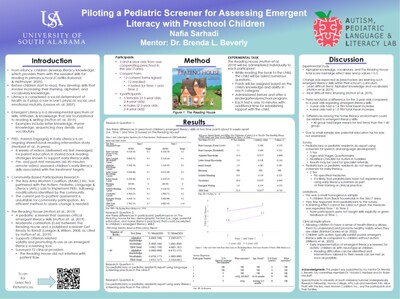
Piloting a Pediatric Screener for Assessing Emergent Literacy with Preschool Children
Nafia Sarhadi
From infancy, children develop literacy knowledge, which provides them with the needed skills for reading in primary school (Castillo-Rabanal &Heitmayer, 2025). Before children start to read, they develop skills that involve increasing their rhyming, alphabet, and vocabulary knowledge. Literacy is considered a social determinant of health as it plays a role in one's physical, social, and emotional maturity (Lesauxet. al, 2007). The Bay Area Women Coalition, (BAWC) Inc. has partnered with the Autism, Pediatric Language & Literacy (APLL) Lab to implement PEEL, following modifications identified by the community. The current pre-to-posttest assessment is unsuitable for community participation. An efficient method to assess change is needed.
-
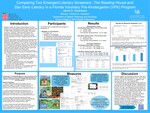
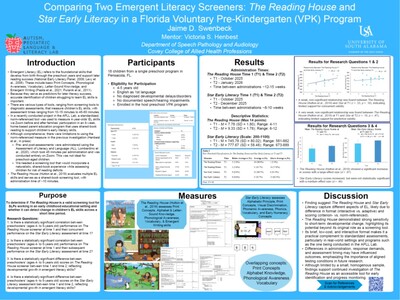
Comparing Two Emergent Literacy Screeners: The Reading House and Star Early Literacy in a Florida Voluntary Pre-Kindergarten (VPK) Program
Jaime D. Swenbeck
Emergent Literacy (EL) refers to the foundational skills that develop from birth through the preschool years and support later reading success (National Early Literacy Panel, 2008; Levy et al., 2006). These include basic Print Concepts, Phonological Awareness, Vocabulary, Letter-Sound Knowledge, and Emergent Writing (Piasta et al., 2021; Puranik et al., 2011). Because they serve as predictors for later literacy success, accurate identification of children struggling to learn EL skills is important. There are various types of tools, ranging from screening tools to diagnostic assessments, that measure children’s EL skills, with assessment times ranging from 10-15 minutes to 45-60 minutes. In a recently conducted project in the APLL Lab, a standardized, norm-referenced tool was used to measure 4-year-olds’ EL skills via Zoom before and after families’ participation in an 8-week, home-based parent education program that uses shared-book reading to support children’s early literacy skills. Although comprehensive, there were limitations to using the norm-referenced measure in the previous investigation (Henbest et al., in press). Pre- and post-assessments were administered using the Assessment of Literacy and Language (ALL; Lombardino et al., 2020), which took 45 minutes per administration and was conducted entirely on Zoom. This was not ideal for preschool-aged children. We needed a screening tool that would incorporate a naturalistic, shared-book experience while assessing children for risk of reading deficits. The Reading House (Hutton et al., 2019) evaluates multiple EL skills and serves as a shared-book screening tool, with administration time of ~10 minutes.
Printing is not supported at the primary Gallery Thumbnail page. Please first navigate to a specific Image before printing.