-
Building Safer Communities Collaborative: Demographics from a Youth Diversion Pilot Project
Caroline O. Dodson, Antonette Francis-Sheaerer PhD, Amber Singleton, Denise Shaw, Kierra Echols, Jarette Maye, Alexis Tanner, L. Lynette Parker, and Ashley Y Williams
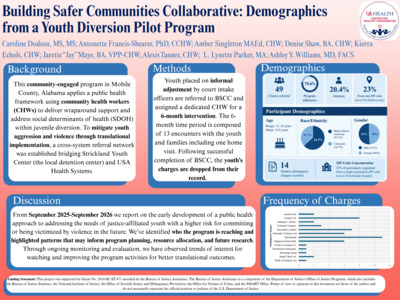
This community-engaged program in Mobile County, Alabama applies a public health framework using community health workers (CHWs) to deliver wraparound support and address social determinants of health (SDOH) within juvenile diversion. To mitigate youth gun violence through translational implementation, a cross-system referral network was established bridging Strickland Youth Center (the local detention center) and USA Health Systems. Youth placed on informal probation are referred to BSCC and assigned a dedicated CHW for a 6-month intervention comprising 13 structured interactions. From September 2025–September 2026, 49 clients were referred, demonstrating high implementation feasibility with 79.6% program adherence (20.4% attrition). Enrolled youth aged 11–18 (14.8) were predominantly Black/African American (63.3%), with a near-equal gender distribution (51% male, 49% female). Fourteen distinct delinquency charges were recorded, led by 'Harassment' at 20% (27% when combined with 'Harassing Communications'). Notably, spatial translation of intake data revealed that 23% of participants originated from a single residential zip code out of 38 in Mobile County—one not traditionally classified as the highest area of crime rates. This highlights the vital role of real-time epidemiological translation in identifying emerging geographic health disparities and unaddressed community risk factors. Referrals, data collection, and outcome evaluations remain ongoing. This project demonstrates early demographic trends, implementation metrics, and cross-sector feasibility of translating evidence-based public health strategies into juvenile justice settings to reduce long-term gun violence risk among justice-impacted youth.
-
I'm Sexy and I know it! Do you?! Candid Conversations with Seniors on Sexual Health
Antonette Francis-Sheaerer PhD, Tameka Dale-Wright, Cassandra Pettway, Thomas D. Cain, L. Lynette Parker, and Ashley Y Williams
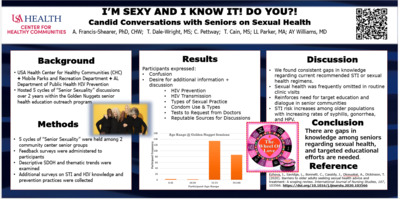
Since 2023, the USA Health Centre for Healthy Communities, in partnership with the City of Mobile Parks and Recreation Department, has implemented the ‘Golden Nuggets’ Seniors Health Education Outreach program cycles at two community senior centers. Among the multi-session curriculum, Session Five—Senior Sexuality—has consistently been one of the most engaged and interactive, co-facilitated with the Alabama Department of Public Health HIV Prevention Unit. This session provides a culturally sensitive forum for African American older adults to voice questions or receive updated information on sexually transmitted infection (STI) prevention and sexual health practices relevant to their aging-in-place lifestyles. Anecdotal participant feedback reveals pervasive knowledge gaps and discomfort regarding current recommended STI or sexual health regimens, as well as a frequent omission of sexual health discussions in routine clinical care consults. Consistent with prior research, these dialogues highlight barriers including cultural and societal expectations around sexuality in later life, stigma and embarrassment in peer and caregiving contexts, and perceived ageism and inadequate training among healthcare professionals, which collectively deter open discussion and care-seeking behaviors. Such barriers also contribute to inconsistent sexual history taking and may inadvertently elevate STI risk among older adults. Concurrent public health data indicates significant STI increases among older populations; for example, commercially insured patients aged 65 and older experienced a 23.8 % rise in STIs between 2020 and 2023, with notable growth in diagnoses of syphilis, gonorrhea, and HPV, and a 16.2 % increase among those aged 55–64 in the same period. These trends reinforce the critical need for targeted education and dialogue. Structured community interventions that provide real conversation opportunities with trusted health communicators such as the Golden Nuggets may be an effective mechanism to reduce stigma, enhance sexual health literacy, and support the quality of life outcomes for seniors choosing to age-in-place
-
Homegrown Justice: Lessons from TraumaInformed Approaches to Improving lives of justicesystem impacted youth
Antonette Francis-Sheaerer PhD, Amber Singleton, and Denise Shaw
Workshop Summary:
This workshop presents best practices derived from the pilot of the Building Safer Communities Collaborative (BSCC)Program launched in 2025. The BSCC is a public health-driven, trauma-informed care (TIC) prevention strategy designed for youth aged 11–18 who are currently on informal probation as opposed to juvenile detention services.
Background:
The USA Health Center for Healthy Communities, in partnership with the Mobile County Juvenile Court System’s Strickland Youth Detention Center, launched the 6 month duration BSCC program with an initial cohort of 40 youth clients. Funded by the Alabama Department of Economic and Community Affairs (ADECA), the initiative employs a public health prevention framework using trauma-informed care approaches to foster positive outcomes for youth, their families, and their broader community environments.
Research indicates that justice-involved youth frequently carry histories of significant childhood adversity. Systematic gaps in the Social Determinants of Health (SDOH)—at both individual and familial levels—are primary drivers of behaviors that lead to justice system involvement. These gaps often restrict access to healthcare and essential societal supports, exacerbating the trauma of scarcity. This lack of support frequently manifests as incidences of interpersonal violence, diminished physical and mental health outcomes, and a lack of equitable resources for redressing lapses in judgement or building resilience to move forward positively beyond mistakes at a young age.
By leveraging the client-led Community Health Worker (CHW) delivery model, the BSCC integrates TIC approaches from initial intake through the program's six-month duration. Through structured screening, social and health coaching, and collaborative training for support professionals in the youth services ecosystem, the program has demonstrated several elements of measurable success in improving outcomes for youth, their families and their surrounding communities.
-
Trauma informed care approach to family violence : Preliminary insights of a pilot youth justice violence prevention program
Antonette Francis-Sheaerer PhD, Amber Singleton, Denise Shaw, Kierra Echols, L. Lynette Parker, Caroline O. Dodson, and Ashley Y. Williams MD
Background: Modern juvenile justice research increasingly identifies family violence as a primary driver of youth legal and social transgressions. To address this, the Strickland Youth Detention Center, in partnership with the USA Health Center for Healthy Communities, launched the Building Safer Communities Collaborative (BSCC)in Mobile, Alabama, in September 2025. This pilot program employs a public health, trauma-informed prevention model to intervene before youth face serious tenure within the justice system.
Methods: The BSCC utilizes a Community Health Worker (CHW) model focusing on 37 youth currently on informal probation. Over a six-month period, the program facilitates twice-monthly encounters with youth and parents. Methodology includes restorative practice tools, pro-social modeling, and comprehensive screenings—including Adverse Childhood Experiences (ACEs), family cohesion surveys, and caregiver assessments—to identify "trauma of lack" and recurrent conflict patterns such as verbal/physical rejection and normalized violent outbursts.
Results: Preliminary case notes and self-disclosed screenings reveal that environmental stressors and systemic trauma predispose both parents and youth to negative physicality as a conflict resolution tool. However, the integration of assigned CHWs for life coaching and reflective restorative practices has broadened the pro-social support network for participants. Initial data indicates a marked improvement in family dynamics and successful deterrence of repeat violent offenses among the majority of participants during the study period.
Conclusion: The BSCC intervention demonstrates that leveraging CHWs to provide trauma-informed, community-centered support can effectively mitigate the risk of recidivism and re-traumatization. By fostering individual accountability, societal growth, and community service, the program offers a scalable alternative to traditional punitive measures in juvenile justice as well as improving community and family capacity for resilience.
Printing is not supported at the primary Gallery Thumbnail page. Please first navigate to a specific Image before printing.