
-
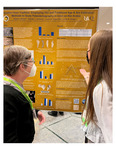
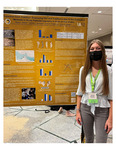
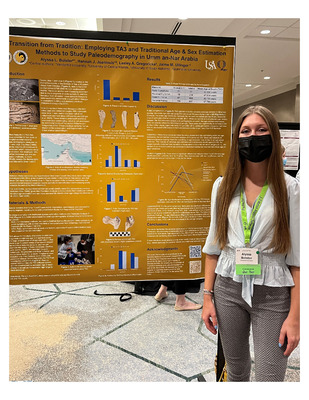
A Transition from Tradition: Employing TA3 and Traditional Age & Sex Estimation Methods to Study Paleodemography in Umm an-Nar Arabia
Alyssa Bolster, Hannah Jeanlouis, Lesley A. Gregoricka, and Jaime M. Ullinger
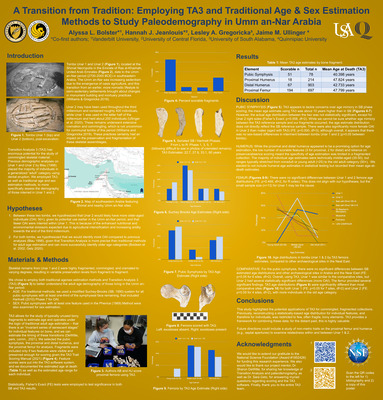
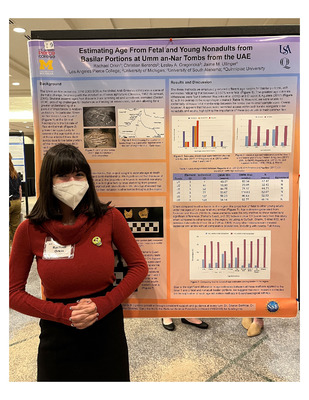
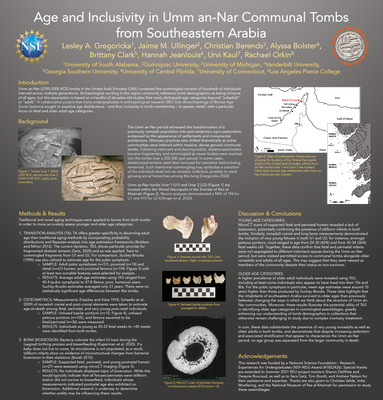
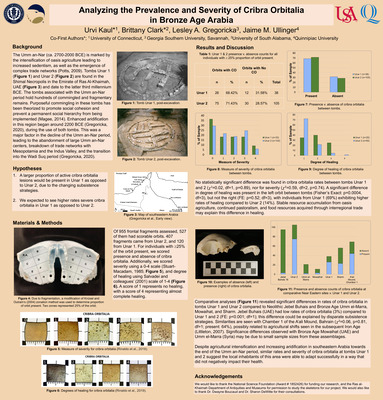
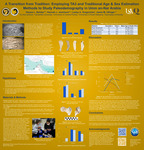
Background: Transition Analysis 3 (TA3) has enormous potential for the study of commingled skeletal material. Previous demographic analyses on commingled remains from Umm an-Nar (2700-2000 BCE) tombs Unar 1 and Unar 2 at the site of Shimal (Ras al-Khaimah, UAE) placed the majority of individuals in a generalized “adult” category using dental eruption. We hypothesized that we would identify more older adults (50+) in both tombs using TA3, and that more would be found in Unar 2, prior to the intensification of agriculture and regional aridification.
Methods: Commingled and fragmentary skeletal fragments (pubic symphyses (n=51), humeri (n=85), femora (n=194)) were sorted and scored if two features were present for TA3 software to estimate age. Age was also estimated using the Suchey-Brooks with Hartnett adaptation.
Results: Proximal and distal humeri delivered average age estimates of 42.7 and 47.8 years, respectively, while mean age-at-death for the femur was 47.8 years and for the pubic symphysis was 40.4 years. Conversely, Suchey-Brooks estimates from the same pubic symphyses gave an average of approximately 31 years. There were no statistically significant age distribution differences in older adults between the two tombs using TA3.
Conclusion: We found that at least some individuals in these communities lived into old age, suggesting that despite the intensification of agriculture, aridification, and other major social changes happening during the third millennium BCE, community structure remained resilient, and that living to older ages was possible for those interred in both tombs.
Funding Statement: This research has been funded through the National Science Foundation Research Experiences for Undergraduates Program (Award #1852426).
Printing is not supported at the primary Gallery Thumbnail page. Please first navigate to a specific Image before printing.