


Shelby Hall Graduate Research Forum Posters
Files
Download Full Poster (828 KB)
Description
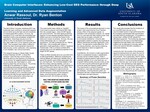
The field of Brain Computer Interfacing (BCI) has traditionally been confined to clinical and research environments due to the high cost and complexity of medical-grade EEG systems. However, the emergence of low-cost hardware exemplified has catalyzed a shift toward accessible, portable BCI applications. While these devices lower the barrier to entry for developers and researchers, they often suffer from a lower signal-to-noise ratio (SNR). This increased noise makes it difficult to extract the clean neural signatures required for high-accuracy control, particularly when operating in non-shielded, real-world environments.
This research focuses on Steady-State Visually Evoked Potentials (SSVEP), a robust BCI paradigm where the brain synchronizes its electrical activity to the frequency of a flickering visual stimulus. By targeting specific frequencies, we can decode user intent based on which flickering object they are focusing on. The primary challenge to be addressed is whether computational techniques specifically Generative Adversarial Networks (GANs) and Deep Neural Networks can compensate for the inherent hardware limitations of low-cost EEG boards. By enhancing the data through augmentation, we aim to achieve performance metrics that rival medical-grade acquisition systems.
Publication Date
3-2026
Department
Computer Science
Disciplines
Analytical, Diagnostic and Therapeutic Techniques and Equipment | Computer Sciences | Neurosciences
Recommended Citation
Rassoul, Anwar, "Brain Computer Interfaces: Enhancing Low-Cost EEG Performance through Deep" (2026). Shelby Hall Graduate Research Forum Posters. 43.
https://jagworks.southalabama.edu/southalabama-shgrf-posters/43
Included in
Analytical, Diagnostic and Therapeutic Techniques and Equipment Commons, Computer Sciences Commons, Neurosciences Commons