


Poster Presentations
Files
Download PDF of poster (1.2 MB)
Description
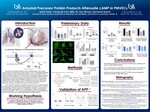
Pseudomonas aeruginosa utilizes a host of virulence factors. One of these virulence factors is the type three secretion system (TTSS). This needlelike apparatus transfers exoenzymes from the bacterial cytosol into the host cell cytosol. One of these exoenzymes, exoenzyme Y or ExoY, binds to its eukaryotic cofactor and begins producing cyclic nucleotides, including cAMP thereby elevating intracellular cAMP. Paradoxically, P. aeruginosa that exclusively express ExoY (ExoY+), producing this increased cAMP signal, disrupt a PMVEC monolayer across 4 hours. When using another lab strain of P. aeruginosa (ExoYK81M) that has a mutation rendering ExoY inactive, the monolayer remained intact across this same time frame. TTSS and ExoY competent P. aeruginosa have been shown to induce PMVECs to release cytotoxic amyloids. One of these amyloids, Aβ, has been shown to bind to the β2 adrenergic receptor, leading to its internalization. Recently, our lab has found that sterile media supernatants or what we designate as “Cytotoxic Supernatants” from a primary infection with P. aeruginosa attenuates β-agonist induced elevations in cAMP. Could Aβ play a role in attenuating stimulated cAMP production?
Publication Date
5-2026
Disciplines
Bacteria | Bacterial Infections and Mycoses | Bacteriology | Biological Phenomena, Cell Phenomena, and Immunity | Cells | Medical Cell Biology | Medical Microbiology | Pathogenic Microbiology | Preventive Medicine | Pulmonology | Respiratory System | Respiratory Tract Diseases
Recommended Citation
Peters, Dylan, "Amyloid Precursor Protein Products Attenuate cAMP in PMVECs" (2026). Poster Presentations. 53.
https://jagworks.southalabama.edu/honors_college_posters/53
Included in
Bacteria Commons, Bacterial Infections and Mycoses Commons, Bacteriology Commons, Biological Phenomena, Cell Phenomena, and Immunity Commons, Cells Commons, Medical Cell Biology Commons, Medical Microbiology Commons, Pathogenic Microbiology Commons, Preventive Medicine Commons, Pulmonology Commons, Respiratory System Commons, Respiratory Tract Diseases Commons