













-
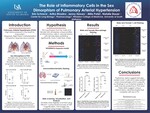
The Role of Inflammatory Cells in the Sex Dimorphism of Pulmonary Arterial Hypertension
Erin M. Schreck
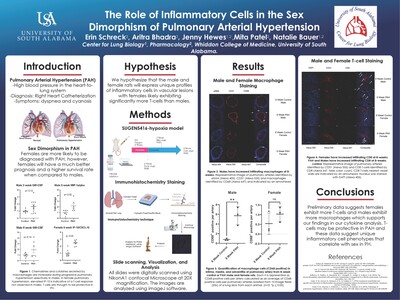
Pulmonary Arterial Hypertension (PAH) is a disease associated with high blood pressure specifically in the lung circulation. Symptoms include dyspnea and cyanosis, and the mean survival post-diagnosis is 2.8 years without treatment. PAH can be characterized by accumulating vascular damage which results in lesion formation causing a decrease in the diameter of vessels, obstruction of flow, and ultimately increased pressure on the right heart leading to failure. These lesions define an arteriopathy that is a hallmark of PAH which is, in part, dependent on infiltration of inflammatory cells into the vascular wall. PAH presents uniquely in males and females with females being diagnosed more often than males, but with males having a much worse prognosis than females. We recently reported that in the SUGEN/Hypoxia model of PAH there is increased circulating MCP-1 and GM-CSF, indicative of macrophage-driven infiltration. Further we found that CXCL-10 was increased in females, indicative of T-cell infiltration. We hypothesized that males would exhibit macrophage expression in the vascular wall, whereas females would have T-cell infiltration. Following histological staining of both male and female samples our preliminary data suggests females exhibit more T cells and male exhibit more macrophages. This data suggests unique inflammatory cell phenotypes that correlate with sex in PH.
-

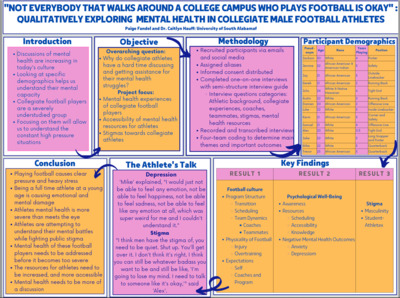
The Attack on Addiction: Is it truly a choice?
Amy L. Thomas
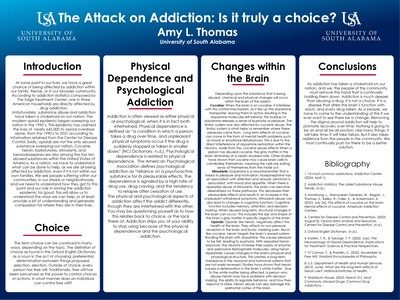
Unfortunately, substance abuse and addiction have taken a chokehold on our nation. The modern opioid epidemic began sweeping our nation in the 1990’s. This epidemic has claimed the lives of nearly 645,000 to opioid overdose alone, from the 1990’s to 2021 according to information retained from the Center for Disease Control (Opioid data, 2023). Sadly, opioids are not the only abused substance sweeping our nation. Cocaine, heroin, barbiturates, stimulants, and benzodiazepines are also among the top ten abused substances within the United States of America (10 Most Common, 2024). As a nation, we have to understand what can be done to help, as we are all being affected by addiction, even if it is not within our own families. We see people suffering within our communities, in our streets or neighborhoods, and we need to understand how they got to this point and our role in solving the addiction epidemic for good. This will allow us to understand the ways we can help, or at least provide a bit of understanding and generate compassion for where they are in their lives. This thesis addresses the argument over addiction and choice, provides an understanding for how different substances alter the brain’s chemistry in different ways, and advocates for comprehensive knowledge of harm reduction, decriminalization, and de-escalation as the most effective solution to this crisis.
-

Gertrude Stein: Autobiography and Play
Ryleigh Thornton
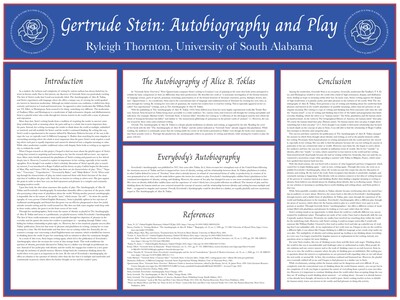
By using Gertrude Stein’s two autobiographies, this thesis attempts to examine to use and evolution of play in writing. In The Autobiography of Alice B. Toklas, play stands within the language and games that Stein invites her readers to engage in. By using Roger Caillois’ characteristics of play, Stein’s writing can be seen as different from the high, serious modernism at the time with writers like William Faulkner and T.S. Eliot. After the publication of Toklas, Stein reverted into a crippling writer’s block because she could no longer find interest in the world to think and write about. However, after an experience with a dead Englishwoman, she was thrown back into a world of questions with no straightforward answer, which lead her to begin writing again. Everybody’s Autobiography is a meditation on these questions that haunted her at first but became a playful mystery to think about.
-
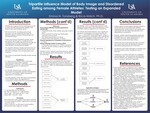
Tripartite Influence Model of Body Image and Disordered Eating among Female Athletes: Testing an Expanded Model
Emma Nyrup Tonsberg
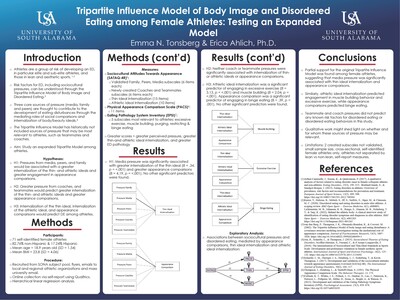
The aim of the study was to investigate how different sources of sociocultural pressure (family, media, peers) described in the Tripartite Influence Model, and additions of teammate- and coach pressures, were associated with thinness-and muscularity internalization and appearance comparisons among athletes. Subsequently, these potential mechanisms were explored as predictors of disordered eating among athletes. Analyses included 71 female athletes. Athletes were recruited through a student subject pool recruitment portal, as well as with local and regional flyers and emails. Participants completed a series of self-report measures in Qualtrics. Hierarchical linear regression analysis was utilized to test the hypotheses. Partial support for the Tripartite Model was found. Results indicated that media pressures were significantly associated with thin ideal internalization and appearance comparisons. Teammate and coach pressures were not associated with ideal internalization or appearance comparisons. Significant associations were found between athletic ideal internalization and engagement in excessive muscle building and exercise behavior. Significant associations also were found between appearance comparisons and binge eating. This research helps highlight the importance of developing targeted interventions for athletes, with particular attention to the media, thin- and athletic ideal internalization, and appearance comparisons.
-
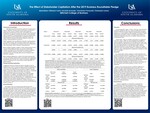
Effect of Stakeholder Capitalism After the 2019 Business Roundtable Pledge
Maximiliano Villarreal-Castro
There has been a shift towards a new model of corporate operation, one which prioritizes not only the company shareholders but anyone affected by its operations, i.e., stakeholders. Although many believe this is a path towards a more equitable future, others fear it could cause agency issues. As a result, companies that focus on ESG/Stakeholder Capitalism may experience the adverse effects of slow growth, costing shareholders, employers, and employees in the long term.
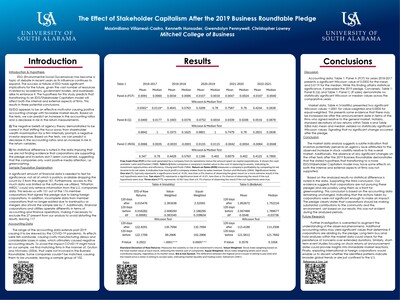
To determine if there was an impact from 'The Shift' to an ESG model by the major corporations, this study compared internal (accounting) and external (market) data. The sample comprised members who signed the 2019 Business Roundtable Pledge. The pledge signed on August 19, 2019, stated that all companies that agreed to sign would begin to adopt a model of ESG/Stakeholder Capitalism.
For the accounting data, changes in selected ratios were compared between the years 2017 to 2022. The market data was analyzed during the set timeframe of 120 days before 'The Shift' to 120 days thereafter. There were very few significant results between the tested variables and accounting ratios, supporting no effect, which implies firms may be greenwashing. The market data test shows that there is little evidence that investors are concerned about switching to stakeholder capitalism. In general, we conclude there was not much change in companies' activities that would affect these variables; however, more testing is needed.
-
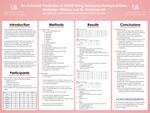
An Actuarial Prediction of ADHD Using Neuropsychological Data
Kimberlyn Williams
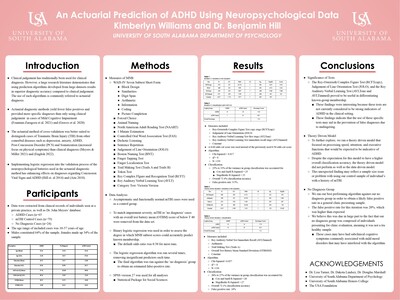
Attention-Deficit/Hyperactivity Disorder (ADHD) is the most common psychiatric diagnosis in children and a frequent psychiatric diagnosis in adults. ADHD is a clinical diagnosis based on self-reported symptoms which makes accurate diagnosis challenging. Actuarial prediction has been demonstrated to be more accurate than clinical judgment. The current study explored an actuarial approach to predicting ADHD based on a comprehensive battery of neuropsychological tests. This project utilized test data from Meyers Neuropsychological Battery (MNB) to develop a logistic regression model to accurately predict diagnosed ADHD cases (n=65) from normal functioning cases (n=79) with a history of Mild Traumatic Brain Injury (mTBI). Binary logistic regression analysis was used to refine a predictive ADHD model based on all available test data. The final model correctly identified 73.4% of total cases. The model had 53.8% accuracy in identifying cases diagnosed with ADHD (sensitivity) and 90.5% accuracy in identifying the normal functioning mTBI control cases (specificity). This model was then compared to a theory-driven model of tests commonly associated with impaired performance in ADHD. The theory-driven model did not perform better than the data driven model. Further, as the data driven model was composed of predictor tests that are not typically associated with cognitive deficits in ADHD, the presented algorithm may be more robust to malingering than other diagnostic methods.
-
Enabling More Efficient Solar Thermal Energy Production and Storage
Allan Wilson
Concentrated Solar Power (CSP) stores & transfers energy using a Thermal Energy Storage Fluid (EIA AEO 2022)
-
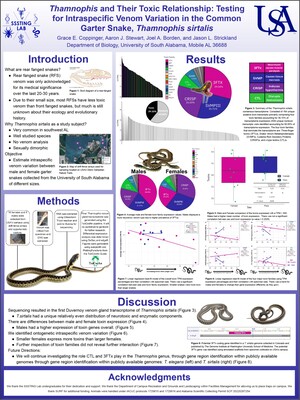
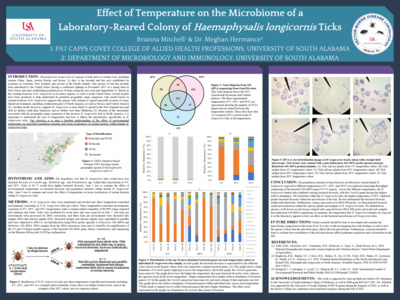
Effect of Temperature on the Microbiome of a Laboratory Reared Colony of Haemaphysalis longicornis Ticks
Brianna Mitchell
Honors research poster.
Haemaphysalis longicornis is a species of tick native to eastern Asia, including eastern China, Japan, eastern Russia, and Korea. To date, it has invaded and has now established its existence in Australia, New Zealand, and several of the Pacific Islands. This species of tick has recently been introduced to the United States, having a confirmed sighting in November 2017 on a sheep farm in New Jersey and since establishing populations in 18 states along the east coast and Appalachia. Based on the existing locations of H. longicornis in its native regions, as well as in the United States, several models have been produced to help understand its potential geographic range expansion. One model based on current locations of H. longicornis suggests this species will continue to spread especially in areas of warm, humid environments, including southeastern parts of North America, as well as Mexico and Central America. Another model, however, suggests H. longicornis is more likely to spread in the New England area and drift no further south than Tennessee and no further west than Oklahoma. Because of the uncertainty associated with the geographic range expansion of the invasive H. longicornis tick in North America, it is important to understand the role of temperature and how it affects the microbiome, specifically in H. longicornis ticks. Our objective is to gain a baseline understanding of the effect of environmental temperature on microbial population structure and tissue localization of certain bacteria within female H. longicornis ticks.
HYPOTHESIS AND AIMS: My hypothesis was that H. longicornis ticks would have less bacterial diversity of Coxiella spp., Rickettsia spp., and Pseudomonas spp. within their microbiome at 4 degrees C and 20 degrees C. Ticks at 30 degrees C would have higher bacterial diversity.
Aim 1 was to examine the effect of environmental temperature on bacterial diversity and population structure within female H. longicornis ticks.
Aim 2 was to examine and assess the effect of temperature on tissue localization of certain bacteria within H. longicornis ticks.
-
Examining NDUFAB1 Expression in Head and Neck Squamous Cell Carcinoma
Addison Stevens
Honors research poster.
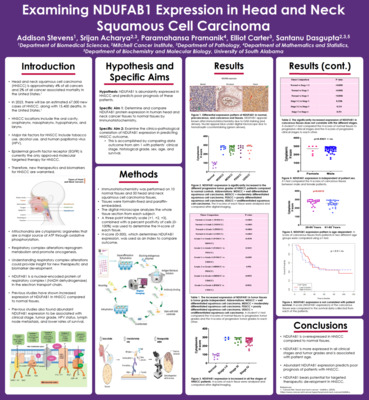
Introduction: Head and neck squamous cell carcinoma (HNSCC) is approximately 4% of all cancers and 2% of all cancer associated mortality in the United States. In 2023, there will be an estimated 67,000 new cases of HNSCC, along with 15,400 deaths, in the United States. HNSCC locations include the oral cavity, oropharynx, nasopharynx, hypopharynx, and larynx. Major risk factors for HNSCC include tobacco use, alcohol use, and human papilloma virus (HPV). Epidermal growth factor receptor (EGFR) is currently the only approved molecular targeted therapy for HNSCC. Therefore, new therapeutics and biomarkers for HNSCC are warranted. Mitochondria are cytoplasmic organelles that are a major source of ATP through oxidative phosphorylation. Respiratory complex alterations reprogram metabolism and promote oncogenesis. Understanding respiratory complex alterations could provide insight for new therapeutic and biomarker development. NDUFAB1 is a nuclear-encoded protein of respiratory complex I (NADH dehydrogenase) in the electron transport chain. Previous studies have shown increased expression of NDUFAB1 in HNSCC compared to normal tissues. Previous studies also found abundant NDUFAB1 expression to be associated with clinical stage, tumor grade, HPV status, lymph node metastasis, and lower rates of survival.
Hypothesis: NDUFAB1 is abundantly expressed in HNSCC and predicts poor prognosis of these patients.
Specific Aim 1: Determine and compare NDUFAB1 protein expression in human head and neck cancer tissues to normal tissues by immunohistochemistry.
Specific Aim 2: Examine the clinico-pathological correlation of NDUFAB1 expression in predicting HNSCC outcome. This is accomplished by comparing data outcome from aim 1 with patients’ clinical stage, histological grade, sex, age, and survival.
-
Applying MCI-062, a Novel Pan-RAS Inhibitor, to Treat KRAS-Mutant Lung Cancer.
Richard Fu
Honors thesis poster presentation.
RAS, one of the most prevalent oncogenes, is mutated in 27% of human cancers. Gainof- function RAS mutations activate multiple downstream pathways, including the RASRAF- MEK-ERK and PI3K/AKT/mTOR pathways, which are critical in tumorigenesis and cancer cell proliferation. The RAS proteins KRAS, HRAS, and NRAS along with their downstream effectors are attractive targets for cancer therapy since they act as frequent drivers in lung, colorectal, and pancreatic cancers. However, RAS proteins have relatively smooth surfaces that lack traditional binding pockets, making inhibitors specific to RAS difficult to create. Recently, a novel small molecule pan-RAS inhibitor named MCI-062 was developed in Dr. Gary Piazza's Drug Discovery Research Center at the Mitchell Cancer Institute. As a pan-RAS inhibitor, MCI-062 is hypothesized to serve as a targeted therapy for RAS-mutant cancers regardless of mutation isoform, including all types of KRAS-mutant lung cancers. The inhibitory effects of MCI-062 were tested on the growth and proliferation of two non-small cell lung cancer cell lines, A549 and H358, using colony formation assays. The cells were plated onto 12-well plates, treated with varying concentrations of MCI-062 in duplicate, and then digitally imaged and analyzed. A549 cells have a KRASG13D mutation, while H358 cells have a KRASG12C mutation. The results indicate that MCI-062 effectively suppresses the growth and proliferation of both A549 and H358 cells despite their differing mutation isoforms, suggesting that MCI-062 successfully functions as a pan-RAS inhibitor.
-
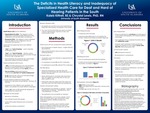
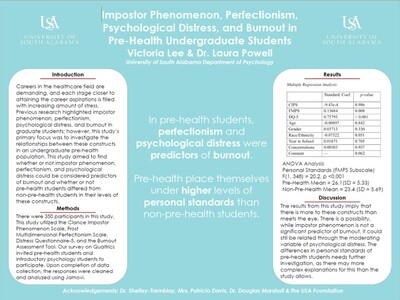
Deficits in Health Literacy and Inadequacies of Specialized Health Care in the South for Deaf and Hard of Hearing Patients
Kaleb Kittrell
Honors Thesis poster presentation.
Health literacy is a constantly evolving concept that requires similarly evolving adaptation and specialization of health care to increase the quality of life for all. One demographic that is largely ignored when it comes to research in health literacy, specifically in the traditional South, is the d/Deaf and hard of hearing/Hard of Hearing (DHH) population. The purpose of this study is to determine the general health literacy of this specific demographic and compare results with that of other demographics to highlight the anticipated deficit in health literacy levels and emphasize the critical need for specialized care. This prospective, non-experimental, descriptive study utilized online survey software to gather anonymous general health literacy levels of those that self-identify as DHH. This survey consisted of the Short Assessment of Health Literacy English (SAHL-E) to determine health literacy level and follow-up questions based on trauma in healthcare. Out of 10 participants, all scored greater than or equal to 14, demonstrating good health literacy. Eight of these participants provided thoughtful responses to the questions about trauma and healthcare. Upon analysis, the data shows that regardless of socio-economic status, those who are DHH are in need of accommodations that allow for consistent, high quality health care. This data contributes not only to the realization of reality for the DHH in health care settings, but also the nationwide goal of increasing general health literacy and thus the quality of life.
-
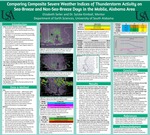
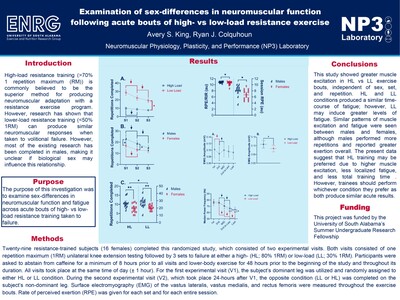
Comparing Composite Severe Weather Indices of Thunderstorm Activity on Sea-Breeze and Non-Sea-Breeze Days in the Mobile, Alabama Area
Elizabeth Seiler
Poster for the Honors Thesis project.
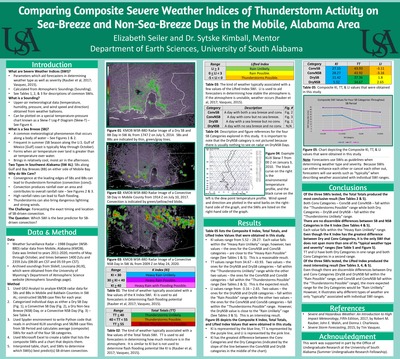
Sea breezes (SB) occur frequently from May through October along the U.S. Gulf of Mexico Coast. One reason why SBs interest forecasters is their ability to spawn summertime thunderstorms, which can cause flash flooding, lightning, and hail. However, forecasting the exact timing and location of SB-driven convection can be challenging. This thesis will focus on Mobile and Baldwin Counties in southwest Alabama, which experience two types of phenomena – SBs along the Gulf of Mexico Coast and bay breezes on either side of Mobile Bay. Over the past years, multiple undergraduate students have analyzed Mobile, Alabama radar imagery of past SB seasons and categorized each day between May 1st and October 31st into one of four categories: Dry SB Days, Convective SB Days, Dry Non-SB (NSB) Days, and Convective NSB Days. Atmospheric balloon (or sounding) data from Slidell, Louisiana is also archived and available from the Wyoming Weather Web (http://weather.uwyo.edu/upperair/sounding.html). Severe weather indices (SWI), which are used to predict the likelihood of thunderstorm formation, can be calculated from sounding data. Using a ten-year archive of SB seasons, we calculated composite (or average) SWIs for each of the four categories by reading in individual soundings from the ten-year archive.
-
Lost in Time and Lost in Space: Chronotopes in Thomas Pynchon’s Against the Day
Stephen Margavio
Honors thesis poster presentation.
In his 1937 essay “Forms of Time and of the Chronotope in the Novel,” Russian literary theorist Mikhail Bakhtin coins the term “chronotope” to discuss the inherently interconnected nature of time and space in narrative constructions. According to Bakhtin, there are a number of specific chronotopes (or space/time configurations) that help to define literary genres. Applying Bakhtin’s concepts to Thomas Pynchon’s novel Against the Day (2006), this thesis examines how the idea of narrative space/time can clarify Pynchon’s use of genre to make socio-political commentary. The first chapter of this thesis focuses on Bakhtin’s “road chronotope,” which is characterized by the chance meeting of people in spaces devoted to movement and transport. In such narrative spaces, we often witness the condensation of social class, time, and history. New York City functions as such a space in Against the Day, and Bakhtin’s ideas help explain how and why Pynchon can embed the 9/11 tragedy inside a scene set nearly a hundred years earlier. The second chapter focuses on Bahktin’s “threshold chronotope.” In fiction, the threshold chronotope is a temporal space removed from the normal flow of narrative time, and often the setting for a character’s extended inaction or contemplation in a moment of crisis. One recurring group of characters in Against the Day is called The Chums of Chance, a group of boy aeronauts who crew the airship Inconvenience. The narrative intentionally separates the Chums from the other characters both physically and metaphorically. Using Bakhtin’s idea of the threshold chronotope helps clarify their position in the novel, explaining why they are often presented as more fictional than the other characters. Moreover, the Chums’ position on the threshold of the novel’s action distances them from the real historical events that are described, providing readers with space and time to contemplate the novel’s political import.